Tag Archives: healthcare

Pay for Performance in Perioperative Pain Management

We have all heard the “doom and gloom” statistics about rising health care spending, and maybe even some of them have begun to sink in since the roll-out of the Affordable Care Act.

For many reasons, the federal government is working to curb health care expenditures, but many of the processes currently attributed to “Obamacare” have been in the works for a long time.  As an example, the Medicare Modernization Act of 2003 introduced the Inpatient Prospective Payment System; this system encouraged participating hospitals to voluntarily report performance data to avoid payment reductions.  The Deficit Reduction Act of 2005 went further by mandating the development of what we now know as pay-for-performance or value-based purchasing (used interchangeably).

In 2012, the Institute of Medicine published “Best Care at Lower Cost:  the Path to Continuously Learning Health Care in America.”  In this report, recommendation 9 refers to performance transparency:  making data related to “quality, prices and cost, and outcomes of care” available to consumers.

What does this mean?  Value-based purchasing in health care is supposed to reward better value, patient outcomes, and innovations – instead of just volume of services (read more).  It is funded by participating institutions based on withholding a set percentage (1.25% currently) of their estimated annual Diagnosis-Related Group (DRG) payments from Center for Medicare and Medicaid Services (CMS).  The percentage is increasing every year and will be 2% by 2017.

For FY2014, the elements of value-based purchasing have been updated to include the Clinical Process of Care Domain, Patient Experience of Care Domain, and a new Outcomes Domain.  The amount that each of these domains contributes to the eventual DRG payment return at the end of the year is 45%, 30%, and 25%, respectively.  Scores in each domain are calculated based on an institution’s improvement compared to its own historical performance and a comparison against national benchmarks (read more).

The Patient Experience Domain is assessed using the Hospital Consumer Assessment of Healthcare Providers and Systems (HCAHPS) survey.  HCAHPS consists of 32 questions, publicly reports its results 4 times a year on http://www.hospitalcompare.hhs.gov, and contains 7 questions that directly or indirectly relate to pain.  For details, please see my previous post “Why We Need Acute Pain Medicine Specialists.”

How do we as anesthesiologists address the need for acute pain medicine physicians and have a positive impact on the patient experience?  We can take the lead in developing multimodal perioperative pain management protocols (1).  For total joint arthroplasty, many of these protocols emphasize opioid-sparing regional anesthesia techniques such as peripheral nerve blocks (PNB) and perineural catheters.  These techniques decrease patients’ reliance on opioids for postoperative pain management and are also associated with fewer opioid-related side effects, better sleep, and higher satisfaction (2).  In addition, greater selectivity in the PNB technique included in a multimodal protocol may even lead to greater functional achievements for total knee arthroplasty (TKA) patients which generates additional value (3).  For more information about TKA perioperative pain management and improving rehabilitation outcomes, please see my previous post “Regional Anesthesia & Rehabilitation Outcomes after Knee Replacement.”

Anesthesiologists can also add value through cost savings for the hospital.  More effective pain management can prevent inadvertent admissions or readmissions due to pain.  In addition, an effective multimodal analgesic protocol can directly or indirectly prevent hospital-acquired conditions (HACs).  HACs are considered by CMS to be “never events” and supposedly preventable (4); hospitals reporting HACs as secondary diagnoses are not entitled to CMS payments for related care.  Examples of HACs include:  urinary and vascular catheter-related infections, surgical site infections, DVT/PE, pressure ulcers, and inpatient falls leading to injury.

Fall riskThere remains substantial controversy related to the potential association between regional anesthesia and inpatient falls (5, 6).  We do know that falls, when they occur, are associated with worse outcomes for patients and higher resource utilization (7) and that falls may occur in lower extremity joint replacement patients with or without PNB (8).  For these reasons, these patients should always be treated as high fall risk, and anesthesiologists can take the lead in developing fall prevention education and fall reduction programs to keep them safe.

In summary, pay for performance in perioperative pain management is already here.  The HCAHPS survey assesses the Patient Experience Domain and can be heavily influenced by the effectiveness of pain management.  There are clear opportunities for anesthesiologists to take an active role in adding value and minimizing risks for surgical patients in the perioperative period.

References:

  1. Hebl JR, Kopp SL, Ali MH, Horlocker TT, Dilger JA, Lennon RL, Williams BA, Hanssen AD, Pagnano MW. A comprehensive anesthesia protocol that emphasizes peripheral nerve blockade for total knee and total hip arthroplasty. J Bone Joint Surg Am 2005;87 Suppl 2:63-70.
  2. Ilfeld BM. Continuous peripheral nerve blocks: a review of the published evidence. Anesth Analg 2011;113:904-25.
  3. Mudumbai SC, Kim TE, Howard SK, Workman JJ, Giori N, Woolson S, Ganaway T, King R, Mariano ER. Continuous Adductor Canal Blocks Are Superior to Continuous Femoral Nerve Blocks in Promoting Early Ambulation After TKA. Clinical orthopaedics and related research 2014;472:1377-83.
  4. Hospital-acquired condition (HAC) in acute inpatient payment system (IPPS) hospitals. http://www.cms.gov/Medicare/Medicare-Fee-for-Service-Payment/HospitalAcqCond/Downloads/HACFactsheet.pdf
  5. Ilfeld BM, Duke KB, Donohue MC. The association between lower extremity continuous peripheral nerve blocks and patient falls after knee and hip arthroplasty. Anesth Analg 2010;111:1552-4.
  6. Memtsoudis SG, Danninger T, Rasul R, Poeran J, Gerner P, Stundner O, Mariano ER, Mazumdar M. Inpatient falls after total knee arthroplasty: the role of anesthesia type and peripheral nerve blocks. Anesthesiology 2014;120:551-63.
  7. Memtsoudis SG, Dy CJ, Ma Y, Chiu YL, Della Valle AG, Mazumdar M. In-hospital patient falls after total joint arthroplasty: incidence, demographics, and risk factors in the United States. The Journal of arthroplasty 2012;27:823-8 e1.
  8. Johnson RL, Kopp SL, Hebl JR, Erwin PJ, Mantilla CB. Falls and major orthopaedic surgery with peripheral nerve blockade: a systematic review and meta-analysis. Br J Anaesth 2013;110:518-28.
Related Posts:

Time to Rethink Preoperative Preparation

The concept of preoperative preparation for patients scheduled for surgery requiring anesthesia is not a new one.  In fact, the idea goes back to Dr. Albert Lee’s description in 1949 (1, 2).  Dr. Lee had observed in his day that patients commonly presented for surgery in various states of poor health; it seemed to make more sense to see these patients before surgery to identify areas of concern early and optimize patients’ conditions they went under the knife.

The model of a stand-alone preoperative evaluation clinic, often run by anesthesiology staff, with a “one stop shop” model for patients’ interviews and examinations, testing, education, and referrals really did not take off until the 1990s (3).  This patient-centered care model was intended to improve efficiency by decreasing the run-around that many patients encountered, but it also saved money for the institution by reducing the ordering of unnecessary tests (4) and decreasing day-of-surgery cancellations (4, 5).

Current State
Current State

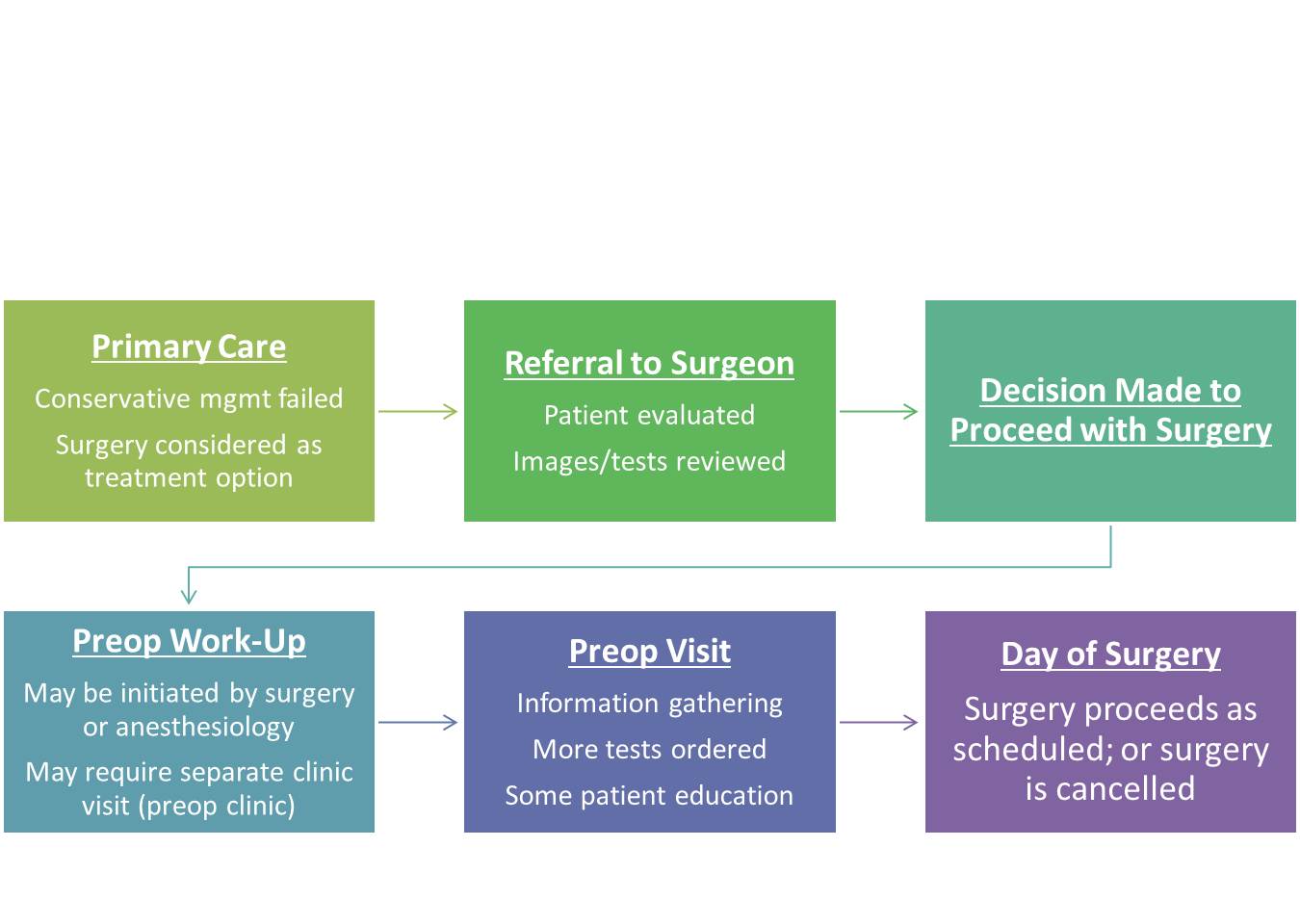
In the present state (assuming an ACO or HMO model), patients are referred to the surgeon by the primary care physician for evaluation of a problem that may be amenable to surgical correction.  If the surgeon deems the patient a surgical candidate, the patient may receive a scheduled date for surgery and then may be referred to the anesthesiology preoperative evaluation clinic (“preop clinic”) for further work-up.  During this encounter, the provider in the preop clinic may request a variety of tests based on the planned surgery and the patient’s comorbid conditions in order to make appropriate recommendations regarding perioperative management to minimize risks.  The American Society of Anesthesiologists (ASA) has published a recent (2012) practice advisory for preanesthesia evaluation to guide this process.

Unfortunately, after nearly 2 decades of employing this model, day of surgery cancellations still occur at various rates around the world.  Some of the reasons are related to factors that preop clinics were meant to avoid:  inadequate preoperative work-up or change in medical condition (6).  Other reasons are patient-driven:  patients’ not showing up (7) or patients’ changing their minds about having surgery (8).  Although not all of these issues are easily solved, it does make me wonder–perhaps it is time for us to rethink the process of preparing patients for surgery.

In our current state, a patient may hypothetically be scheduled for surgery in 8 weeks, a date agreed upon by the patient and surgeon based on available dates.  Even if a preop clinic visit takes place the same day as the surgery clinic visit, this only allows 2 months to optimize a patient’s chronic medical conditions (e.g., hypertension, diabetes, coronary artery disease) that took years to develop.  Imagine if the timeline was even shorter, like 3 weeks.  Add to this time pressure the tremendous physiologic stress that surgery and the subsequent rehabilitation put on the body, and it is not difficult to see why patients can still be cancelled on the day of surgery when they present with abnormal vital signs or test results, making the risks seem too high.  We would not expect ourselves to run a marathon without adequate training and preparation on short notice–why would we do this to our patients having elective surgery?

Future State
Future State

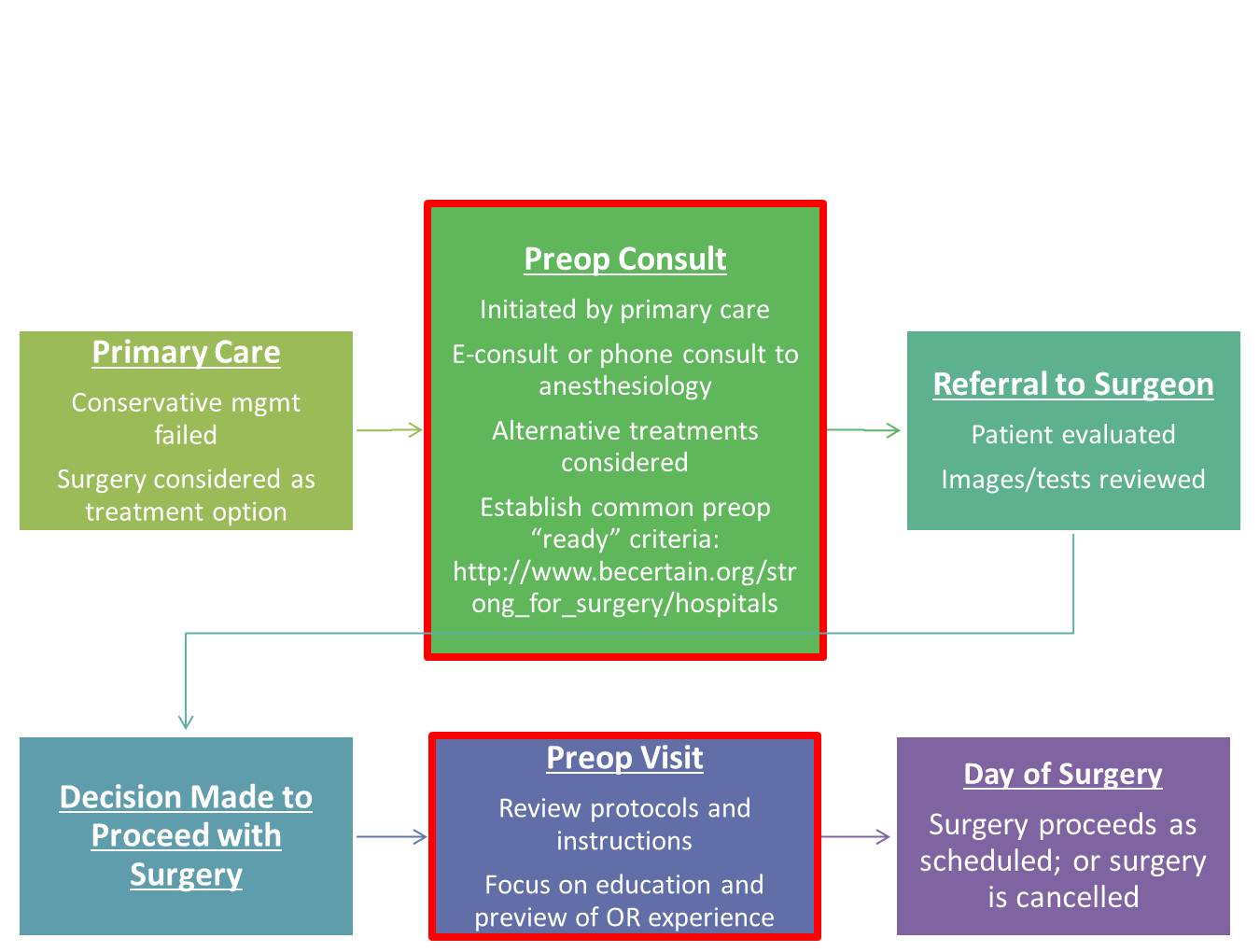
How can we improve preoperative preparation?  I think it still starts with the primary care physician.  With advances in technology such as telemedicine and e-consults (or low-tech phone calls), we have ways to create a direct interface between primary care physicians and anesthesiologists to discuss advanced preparation of patients who may undergo elective surgical procedures.

This coordinated care model is consistent with ASA’s Perioperative Surgical Home.  Early consultation may involve assessment of a patient’s risks and benefits from the procedure, consideration of alternative treatments, and development of a plan to optimize the patient’s comorbid conditions, medication management, and nutrition.  Strong for Surgery is a program that provides patients and clinicians useful checklists based on best-available evidence to guide early preoperative preparation related to smoking cessation, nutrition, glycemic control, and medication management.  For elective surgery, the decision when to refer the patient to a surgeon can be made jointly by the primary care physician and anesthesiologist.  Prior to surgery, the preop clinic visit should still take place, but the focus no longer needs to be on information-gathering and ordering a battery of tests; rather, the goals should be to review pertinent instructions, preview the perioperative experience for patients, and address any logistical or scheduling issues raised by patients to prevent their not showing up or changing their minds at the last minute.  Let’s get started.

For more information, check out this brilliant and inspiring video from the Royal College of Anaesthetists “Perioperative Medicine:  the Pathway to Better Surgical Care.

REFERENCES

  1. Lee JA. The anaesthetic out-patient clinicAnaesthesia. 1949 Oct;4(4):169-74.

  2. Yen C, Tsai M, Macario A. Preoperative evaluation clinicsCurr Opin Anaesthesiol. 2010 Apr;23(2):167-72.

  3. Fischer SP. Cost-effective preoperative evaluation and testingChest. 1999 May;115(5 Suppl):96S-100S.

  4. Fischer SP. Development and effectiveness of an anesthesia preoperative evaluation clinic in a teaching hospitalAnesthesiology. 1996 Jul;85(1):196-206.

  5. Ferschl MB, Tung A, Sweitzer B, Huo D, Glick DB. Preoperative clinic visits reduce operating room cancellations and delaysAnesthesiology. 2005 Oct;103(4):855-9.

  6. Xue W, Yan Z, Barnett R, Fleisher L, Liu R. Dynamics of Elective Case Cancellation for Inpatient and Outpatient in an Academic CenterJ Anesth Clin Res. 2013 May 1;4(5):314.

  7. Kumar R, Gandhi R. Reasons for cancellation of operation on the day of intended surgery in a multidisciplinary 500 bedded hospital. J Anaesthesiol Clin Pharmacol. 2012 Jan;28(1):66-9.

  8. Caesar U, Karlsson J, Olsson LE, Samuelsson K, Hansson-Olofsson E. Incidence and root causes of cancellations for elective orthopaedic procedures: a single center experience of 17,625 consecutive casesPatient Saf Surg. 2014 Jun 2;8:24.

Related Posts:

Anesthesiology and Perioperative Outcomes Research: Where Should We Focus?

Since 2012, the American Society of Anesthesiologists has promoted the Perioperative Surgical Home model in which anesthesiologists function as leaders in the coordination of perioperative care for surgical patients to improve outcomes (1,2). While anesthesiologists globally have had similar interests over the years, the unifying challenge continues to be the selection of outcomes and demonstration of improvement due to the anesthesiologist’s role and/or choice of anesthetic or analgesic technique. Since the types of outcomes and frequency of occurrence vary widely, a comprehensive discussion of perioperative outcomes is beyond the scope of this summary. Therefore, this review will focus on select anesthesiologist-driven factors related to acute pain management and anesthetic technique on perioperative outcomes and potential research directions.

Rare Outcomes and Big Data

For anesthesiologists, avoiding adverse events of the lowest frequency (death, recall, and nerve injury) receives highest priority with death ranking first among complications to avoid (3). Studies involving rare outcomes, positive or negative, will invariably require accumulation of “big data.” Such studies must either involve multiple institutions over a long study period (if prospective) or access data involving a large cohort of patients for retrospective studies; these study designs involving longitudinal data may also require advanced statistical methods (4). For example, Memtsoudis and colleagues sought to evaluate postoperative morbidity and mortality for lower extremity joint arthroplasty patients in a recent study (5). They utilized a large nationwide administrative database maintained by Premier Perspective, Inc. (Charlotte, NC, USA); the study data were gathered from 382,236 patients in approximately 400 acute care hospitals throughout the United States over 4 years (5). Other retrospective cohort studies comparing the occurrence of perioperative complications such as surgical site infections, cardiopulmonary morbidity, and mortality have used the American College of Surgeons National Surgical Quality Improvement Project (NSQIP) (6-8). NSQIP originally started within the Veterans Health Administration (VHA) system in the 1980s with a small sample of hospitals; this project, which included public reporting of outcomes data, eventually expanded to include all VHA surgical facilities and others outside the VHA system (9). Multi-center prospective registries such as the SOS Regional Anesthesia Hotline (10, 11) and AURORA (12, 13) have been developed for outcomes research and have reported the occurrence rates of rare complications related to regional anesthesia. The disadvantages to these data-driven studies include lack or randomization introducing potential bias, missing or incorrectly coded data, inability to draw conclusions regarding causation, and restrictions to access such as information security issues and/or cost (e.g., the Premier database). However, these retrospective cohort database studies may offer large samples sizes and administrative data from actual “real world” patients over a longer period of time and may identify important associations that influence clinical practice and generate hypotheses for future prospective studies.

Anesthesia Type and Perioperative Mortality

Based on the study by Memtsoudis and colleagues, overall 30-day mortality for lower extremity arthroplasty patients is lower for patients who receive neuraxial and combined neuraxial-general anesthesia compared to general anesthesia alone (5). In most categories, the rates of occurrence of in-hospital complications are also lower for the neuraxial and combined neuraxial-general anesthesia groups vs. the general anesthesia group, and transfusion requirements are lowest for the neuraxial group compared to all other groups (5). Studies using NSQIP have reported no difference in 30-day mortality for carotid endarterectomy patients associated with anesthetic technique although regional anesthesia patients are more likely to have a shorter operative time and next-day discharge (8); similarly, there is no difference in 30-day mortality for endovascular aortic aneurysm repair although general anesthesia patients are more likely to have longer length of stay and pulmonary complications (14).

Perioperative Analgesia and Cancer Recurrence

In a relatively-small matched retrospective study, Exadaktylos and colleagues have reported lower rates of recurrence and metastasis for breast cancer surgery patients who receive paravertebral analgesia vs. conventional systemic opioids (15). Although the exact mechanism was not well-understood at that time (regional anesthesia vs. reduction in the use of anesthetic agents and opioids), clinical and basic science research in this area has grown rapidly and has demonstrated mixed results. A follow-up study involving 503 patients who underwent abdominal surgery for cancer and were previously enrolled in a large multi-center clinical trial (16) and a retrospective database study of 424 colorectal cancer patients who underwent laparoscopic resection (17) have not shown a difference in recurrence-free survival or mortality. A recent meta-analysis including 14 prospective and retrospective studies involving cancer patients (colorectal, ovarian, breast, prostate, and hepatocellular) demonstrates a positive association between epidural analgesia and overall survival but no difference in recurrence-free survival compared to general anesthesia with opioid analgesia (18).

Analgesic Technique and Persistent Postsurgical Pain

Chronic pain may develop after many common operations including breast surgery, hernia repair, thoracic surgery, and amputation and is associated with severe acute pain in the postoperative period (19). While regional analgesic techniques are effective for acute pain management, currently-available data are inconclusive with regard to their ability to prevent the development of persistent postsurgical pain (20-22). There is an opportunity to use larger databases to investigate this issue further.

Ultrasound and Patient Safety

In 2010, the American Society of Regional Anesthesia and Pain Medicine published a series of articles presenting the evidence basis for ultrasound in regional anesthesia (23). According to the article focused on patient safety, evidence at the time suggested that ultrasound may decrease the incidence of minor adverse events (e.g., hemidiaphragmatic paresis from interscalene block or inadvertent vascular puncture), but serious complications such as local anesthetic systemic toxicity (LAST) and nerve injury did not occur at different rates based on the nerve localization technique (24). Since then, a large prospective multi-center registry study has shown that the use of ultrasound in regional anesthesia does reduce the incidence of LAST compared to traditional techniques (13). Similar methodology may be applied to other rare complications associated with anesthetic interventions.

Perioperative Medicine and Health Care Costs

Approximately 31% of costs related to inpatient perioperative care is attributable to the ward admission (25). Anesthesiologists as perioperative physicians have an opportunity to influence the cost of surgical care by decreasing hospital length of stay through effective pain management and by developing coordinated multi-disciplinary clinical pathways (26, 27).

REFERENCES

  1. Vetter TR, Goeddel LA, Boudreaux AM, Hunt TR, Jones KA, Pittet JF. The Perioperative Surgical Home: how can it make the case so everyone wins? BMC anesthesiology. 2013;13:6.
  2. Vetter TR, Ivankova NV, Goeddel LA, McGwin G, Jr., Pittet JF. An Analysis of Methodologies That Can Be Used to Validate if a Perioperative Surgical Home Improves the Patient-centeredness, Evidence-based Practice, Quality, Safety, and Value of Patient Care. Anesthesiology. Dec 2013;119(6):1261-1274.
  3. Macario A, Weinger M, Truong P, Lee M. Which clinical anesthesia outcomes are both common and important to avoid? The perspective of a panel of expert anesthesiologists. Anesth Analg. May 1999;88(5):1085-1091.
  4. Ma Y, Mazumdar M, Memtsoudis SG. Beyond repeated-measures analysis of variance: advanced statistical methods for the analysis of longitudinal data in anesthesia research. Reg Anesth Pain Med. Jan-Feb 2012;37(1):99-105.
  5. Memtsoudis SG, Sun X, Chiu YL, et al. Perioperative comparative effectiveness of anesthetic technique in orthopedic patients. Anesthesiology. May 2013;118(5):1046-1058.
  6. Liu J, Ma C, Elkassabany N, Fleisher LA, Neuman MD. Neuraxial anesthesia decreases postoperative systemic infection risk compared with general anesthesia in knee arthroplasty. Anesth Analg. Oct 2013;117(4):1010-1016.
  7. Radcliff TA, Henderson WG, Stoner TJ, Khuri SF, Dohm M, Hutt E. Patient risk factors, operative care, and outcomes among older community-dwelling male veterans with hip fracture. J Bone Joint Surg Am. Jan 2008;90(1):34-42.
  8. Schechter MA, Shortell CK, Scarborough JE. Regional versus general anesthesia for carotid endarterectomy: the American College of Surgeons National Surgical Quality Improvement Program perspective. Surgery. Sep 2012;152(3):309-314.
  9. Ingraham AM, Richards KE, Hall BL, Ko CY. Quality improvement in surgery: the American College of Surgeons National Surgical Quality Improvement Program approach. Advances in surgery. 2010;44:251-267.
  10. Auroy Y, Benhamou D, Bargues L, et al. Major complications of regional anesthesia in France: The SOS Regional Anesthesia Hotline Service. Anesthesiology. Nov 2002;97(5):1274-1280.
  11. Auroy Y, Narchi P, Messiah A, Litt L, Rouvier B, Samii K. Serious complications related to regional anesthesia: results of a prospective survey in France. Anesthesiology. Sep 1997;87(3):479-486.
  12. Barrington MJ, Watts SA, Gledhill SR, et al. Preliminary results of the Australasian Regional Anaesthesia Collaboration: a prospective audit of more than 7000 peripheral nerve and plexus blocks for neurologic and other complications. Reg Anesth Pain Med. Nov-Dec 2009;34(6):534-541.
  13. Barrington MJ, Kluger R. Ultrasound guidance reduces the risk of local anesthetic systemic toxicity following peripheral nerve blockade. Reg Anesth Pain Med. Jul-Aug 2013;38(4):289-297.
  14. Edwards MS, Andrews JS, Edwards AF, et al. Results of endovascular aortic aneurysm repair with general, regional, and local/monitored anesthesia care in the American College of Surgeons National Surgical Quality Improvement Program database. J Vasc Surg. Nov 2011;54(5):1273-1282.
  15. Exadaktylos AK, Buggy DJ, Moriarty DC, Mascha E, Sessler DI. Can anesthetic technique for primary breast cancer surgery affect recurrence or metastasis? Anesthesiology. Oct 2006;105(4):660-664.
  16. Myles PS, Peyton P, Silbert B, Hunt J, Rigg JR, Sessler DI. Perioperative epidural analgesia for major abdominal surgery for cancer and recurrence-free survival: randomised trial. BMJ. 2011;342:d1491.
  17. Day A, Smith R, Jourdan I, Fawcett W, Scott M, Rockall T. Retrospective analysis of the effect of postoperative analgesia on survival in patients after laparoscopic resection of colorectal cancer. Br J Anaesth. Aug 2012;109(2):185-190.
  18. Chen WK, Miao CH. The effect of anesthetic technique on survival in human cancers: a meta-analysis of retrospective and prospective studies. PloS one. 2013;8(2):e56540.
  19. Kehlet H, Jensen TS, Woolf CJ. Persistent postsurgical pain: risk factors and prevention. Lancet. May 13 2006;367(9522):1618-1625.
  20. Kairaluoma PM, Bachmann MS, Rosenberg PH, Pere PJ. Preincisional paravertebral block reduces the prevalence of chronic pain after breast surgery. Anesth Analg. Sep 2006;103(3):703-708.
  21. Schnabel A, Reichl SU, Kranke P, Pogatzki-Zahn EM, Zahn PK. Efficacy and safety of paravertebral blocks in breast surgery: a meta-analysis of randomized controlled trials. Br J Anaesth. Dec 2010;105(6):842-852.
  22. Wildgaard K, Ravn J, Kehlet H. Chronic post-thoracotomy pain: a critical review of pathogenic mechanisms and strategies for prevention. Eur J Cardiothorac Surg. Jul 2009;36(1):170-180.
  23. Neal JM, Brull R, Chan VW, et al. The ASRA evidence-based medicine assessment of ultrasound-guided regional anesthesia and pain medicine: Executive summary. Reg Anesth Pain Med. Mar-Apr 2010;35(2 Suppl):S1-9.
  24. Neal JM. Ultrasound-guided regional anesthesia and patient safety: An evidence-based analysis. Reg Anesth Pain Med. Mar-Apr 2010;35(2 Suppl):S59-67.
  25. Macario A, Vitez TS, Dunn B, McDonald T. Where are the costs in perioperative care? Analysis of hospital costs and charges for inpatient surgical care. Anesthesiology. Dec 1995;83(6):1138-1144.
  26. Ilfeld BM, Mariano ER, Williams BA, Woodard JN, Macario A. Hospitalization costs of total knee arthroplasty with a continuous femoral nerve block provided only in the hospital versus on an ambulatory basis: a retrospective, case-control, cost-minimization analysis. Reg Anesth Pain Med. Jan-Feb 2007;32(1):46-54.
  27. Jakobsen DH, Sonne E, Andreasen J, Kehlet H. Convalescence after colonic surgery with fast-track vs conventional care. Colorectal disease : the official journal of the Association of Coloproctology of Great Britain and Ireland. Oct 2006;8(8):683-687.


Related Posts: